Thursday, December 16, 2010

Ma relation avec Napoléon (My Relationship with Napoleon)


Over the course of my political career, I have served as a prime minister for many royal authorities, but none more willingly, and reluctantly, than my service under Napoleon Bonaparte.
With the rise of Napoleon in the latter years of the French Revolution, I was made his foreign minister in 1797 due to my unparalleled diplomatic skills (how else would I have been able to serve as both Napoleon’s and Louis XVIII’s foreign minister, whom were political enemies against each other.) Some of my few achievements concerning Napoleon includes the support I presented that helped Napoleon gain power with the Consulate (which ultimately led to Napoleon’s dictatorship over France) and helping bring about the Concordat, which removed the threat of the Catholic Church and gave Napoleon even more power over religious affairs.
But as time passed, Napoleon has become even more dictatorial over the French Empire, which has prompted me to spoil his overly ambitions. After Napoleon’s decision to gain the Spain, I resigned but remained in the imperial council and continued as a grand chamberlain till 1809. Ironically though, my own house (uhhh…since when did my house become worthy of imprisonment?) was decided to be the prison of the Spanish Royalty after Napoleon’s invasion from 1803-1813. Anyways, as Napoleon’s power continued to increase, I believed that a strong Austrian Empire was needed to maintain stability among the European countries. My first step was to persuade my Russian ally, Czar Alexander I, to detest Napoleon’s designs for the attack on Austria. The opposition he presented to Napoleon was weak (come on Czar, grow a pair and show him who’s boss…besides, he’s short.) and I had to reinforce the Russian monarch’s confidence. My work was paid off as we rebuked Napoleon's attempts to form a direct anti-Austrian military alliance.
Anyways, Napoleon soon found out about my actions and called me out for treason, though he believed that killing me was not worth the time. He even metaphorically insulted me, saying that I was a “shit in a silk stocking” (that was weak by the way).
"Pity that so great a man should have been so badly brought up!"
After his decision to invade Russia (I was a harsh critic and besides, the invasion failed miserably), we officially parted our separate ways (although he did come back and recruit me when he regained his power, but I declined as he was past his prime).


Wednesday, December 15, 2010

Restauration (Restoration)


It’s been awhile since I last wrote about my interesting and luscious life (hopefully that attracted new readers…).
First, the bad news…
In April of 1814, the dictatorial Napoleon Bonaparte was succeeded by Louis XVIII, brother of the guillotined Louis XVI (How in the world did that happen?). And I was a key component in restoring the monarchy in the House of Bourbons. Unfortunately, the monarchy failed to keep the common public in content (sigh…they never learn). Eventually, King Louis XVIII experienced exploding civil orders and collapsing civil authority which ultimately forced the monarchy to flee France and reside in the city of Ghent. And to my disgust, Napoleon returned with his giant ego and once again claimed himself emperor of the French Empire. Not for long though, as he was defeated at the Battle of Waterloo during the Hundred Days. This led to the second restoration of King Louis XIII on July 8, 1815 and eventually the July Revolution of 1830, where Louis Philippe rose to power.
Now the good news…
My signing of the Treaty of Paris ended the wars between France and the Sixth Coalition (consisted of Austria, Prussia, Spain, Portugal, Britain, and the Dutch Republic) and removed the threat of France’s separation by the victors of the war. In addition, I was able to negotiate with my fellow peers at the Congress of Vienna concerning the ongoing calamities experienced throughout Europe. My diplomatic skills ultimately garnered favorable terms for France during the collaboration, as my country kept their 1792 boundaries (including those lost in the war) without much complication and established new control over papal Avignon, Montbéliard (Mompelgard) and Salm, which had been independent at the start of the French Revolution in 1789.

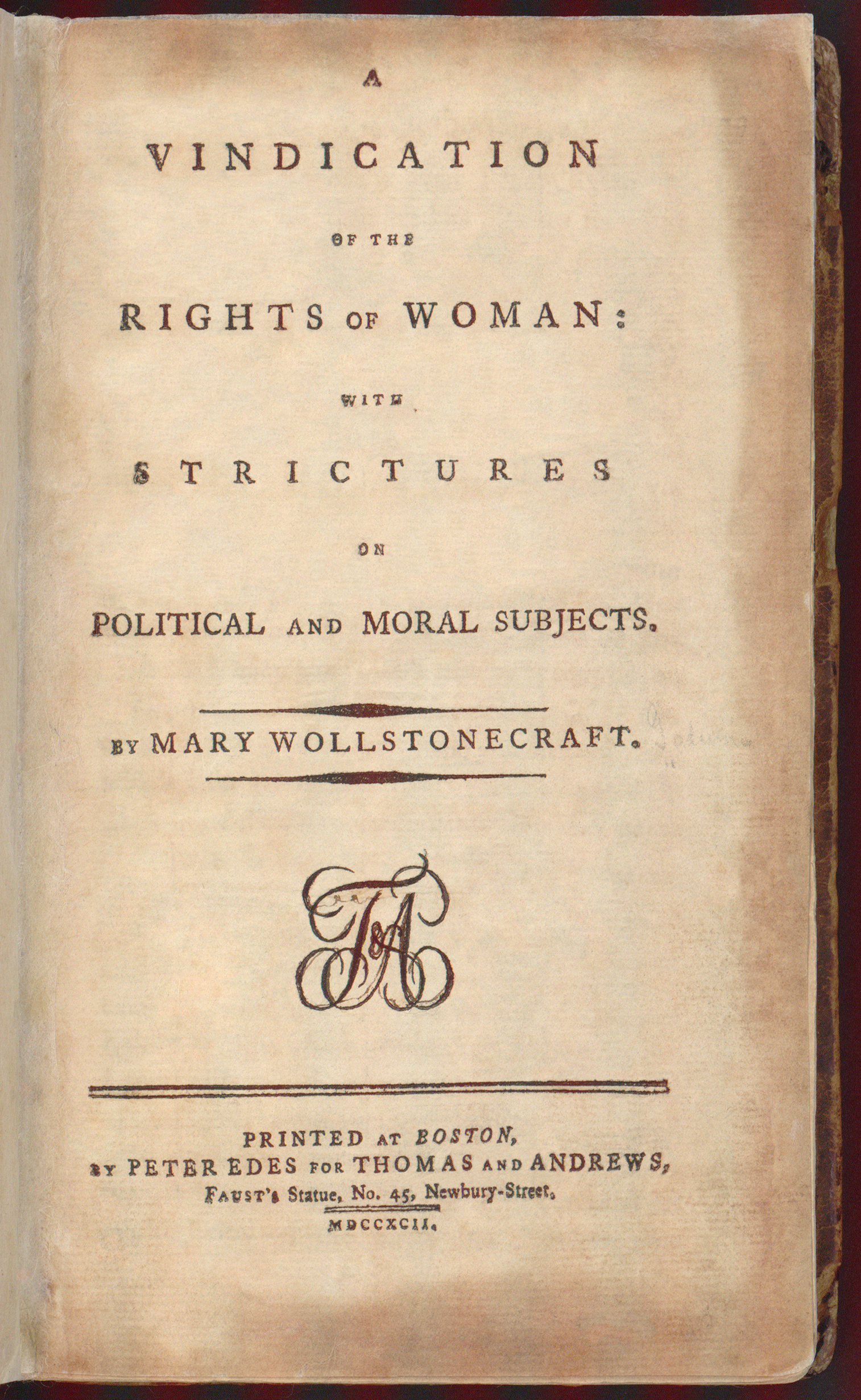
Nice essayer, Wollstonecraft (Nice try, Wollstonecraft)

File:Vindication1b.jpg
Mary Wollstonecraft's A Vindication of the Rights of Woman
(I forgot where I put it...probably lost it)
I admit that I enjoy women and their wondrous qualities, but in no way do they deserve the same education as men.
I made this very clear with my Rapport sur l'instruction publique, in which I had written:
“Let us bring up women, not to aspire to advantages which the Constitution denies them, but to know and appreciate those which it guarantees them. . . Men are destined to live on the stage of the world. A public education suits them: it early places before their eyes all the scenes of life: only the proportions are different. The paternal home is better for the education of women; they have less need to learn to deal with the interests of others, than to accustom themselves to a calm and secluded life.”
But naturally, I faced opposition; especially from Madame Wollstonecraft.
She responded by publishing her own work entitled A Vindication of the Rights of Woman, which was dedicated to me (I feel so special…). It is considered to be one the very first works that concerned feminist philosophy (…I have absolutely no idea why I wrote that…). Anyways Madame Wollstonecraft stated, as I recall:
"Having read with great pleasure a pamphlet which you have lately published (my Rapport sur l'instruction publique), I dedicate this volume to you; to induce you to reconsider the subject, and maturely weigh what I have advanced respecting the rights of woman and national education."
Oh really now?
Nice try, but I stand firm in beliefs. Women, I must confess, are more than just emotional indulgences. BUT…I still believe women are more suited to a domestic education and the daily chores of the common family household. Men on the other hand, thrive on the political stage of the French Empire, which requires the best education.
Simply put, MEN are BETTER than women (cliché statement).
That’s a FACT for life (ok not really…it’s just my opinion).


Tuesday, December 14, 2010

Mes Joies Dans La Vie (My Joys in Life)


The astonishing Château Haut-Brion

Women. Wine. Food. And…more women.

They are my lusts for life. My life seems to bear no future without them.

My interests in food and wine are undeniable, for I have spent a great deal of money to satisfy my desires in these subjects. I am a great conversationalist, and in addition to being a revered gourmet, I am believed to be a fine wine connoisseur. From 1801 to 1804, I owned Château Haut-Brion in Bordeaux, a fine wine estate that stood among the most prestigious in the Bordeaux region of France. I also hired the renowned French chef Carême, one of the first celebrity chefs known as the "chef of kings and king of chefs", and I spent an hour every day with him.

As for women…they just keep me company. (I’m joking!!!)

I believe that I lived the life of a bachelorette (until I married Catherine Worlée Grand), and people consider me to be a womanizer. But…that’s not important. Women have always influenced me in my political decisions and tactics. A good friend, the gorgeous Germaine de Staël, was a key component in returning me to France from my American exile and having me made a foreign minister. So here's a shout-out to Madame Germaine de Staël for your generous help.

And how can I forget my wife.

I met Catherine Worlée Grand in Paris (obviously…where else than the “city of love”…actually its “lights”, but I prefer “love”) and married her after her divorce with Monsieur Grand (I forgot his first name…). Anyways, ironically, I tried to prevent the marriage but was compelled to do so by Napoleon to retain my political position and career. We ended drifting apart into our own personal desires and eventually I left her with some money to carry on with her femininity. But I have to admit that Catherine, to say the least, was extremely beautiful (I mean she had to be…considering that she’s my wife). But unfortunately, she was more known for her ingenuous public comments and she did not know when to stop. She wasn’t very bright either (Catherine dear, if you are reading my blog, I apologize for the comments. But they are my opinion, and you can’t do anything about it…so…TOOO BAADDD…). But yes, Catherine was my only wife (which is something to be proud of) and she was a rarity…sort of.


Monday, December 13, 2010

L'histoire De Ma Vie (My Life Story)

File:Charles-Maurice de Talleyrand-Périgord.PNGMy true name is Charles Maurice de Talleyrand-Périgord, but I am more commonly referred to as Talleyrand. I was born in the beautiful city of Paris into one of the most prestigious and revered aristocratic families in all of Europe. My father was the great Charles Daniel, Comte de Talleyrand, a lieutenant general in the French army, and I being his oldest son, was destined to follow in his footsteps and emulate his military glory. But a childhood incident that resulted in a permanent limp deprived me of most physical activities, especially any hope for military success (…sniff). Ultimately, my father wished, or rather forced, me to be acquainted in the ecclesiastic affairs; even though I greatly despised the idea for that my father himself lacked the experience of priesthood. But naturally, I fulfilled my father’s request and attended many schools to refine my intellectual knowledge of the church and its affairs. Through a series of rapid promotions, I eventually became the appointed bishop of Autun and was sanctified the next year, just before the infamous French Revolution.

With the establishment of the Estates-General in 1789, I was quickly made deputy and representative of the First Estate. By calling for confiscation of church property to fund the new government and supporting the Civil Constitution of the Clergy, I quickly became known as the “bishop of the revolution”. Much to the disgust of Pope Pius VI (Pope who?), I was excommunicated in 1790. In 1792, I was sent to England as an envoy to keep their country in a neutral state during the wars between the fellow neighbors of the French Empire. But my attempt was soon concluded as a failure as the French invasion of the Austrian Netherlands, the rise of the revolutionary mindset, and the execution of Louis XVI led to the inevitable participation of the British army. I was later condemned for being an émigré (great thanks to my fellow countrymen for your indictment), or a social exile, and was soon expelled from the British Empire.

I left England in 1794 and landed on the shores of the American Colonies. I visited vast parts of the young nation and mostly took my time speculating the lands of the new frontier. I returned to France in 1796, after the formation of the Directory, and was made foreign minister in July, 1797. I was forced to resign my position as foreign minister in 1799 due to suspicion for my commitment to the ideas of a republican government. From there, I became acquainted with the notorious Napoleon Bonaparte and soon served under him as his own foreign minister. But I was soon disgusted with his undeniable ambition and lust for war and I hastily sought to thwart my master’s plan for even greater dictatorial power. Suspicions of my plan soon arose and I was soon dismissed of my position. I was allowed to reside in my country estate and from there I began my acquaintance with Louis XVIII. As head of a revised government, I was an essential figure in the first process of restoring the French monarchy.

Again named the foreign minister (for like the billionth time), I was able to win the favor the Allies for the Bourbons and garner some favorable terms for France in the Peace of Paris. My brilliance (not being cocky…and I am like…super intelligent) was again evidenced by my ability to turn the victors against one another to my beloved France’s advantage. But my cunning deceit was stalled by the discontent of the Allies when France welcomed back Napoleon in the Hundred Days, and the state of France was returned to its prerevolutionary condition.

I spent the latter years of my profession as a prime minister and foreign minister under King Louis XVIII but like always (…sigh), I was dismissed of my position. I spent the remainder of my years as a member of the Chamber of Peers, and I most certainly always voted against the government. I have continued on in my last diplomatic affairs, encouraging Louis Philippe to seize the crown and then participating in the signing of the Quadruple Alliance of 1834 (with England, Spain, and Portugal), which secured Anglo-French alliance in support of the constitutional government in Spain against the Carlist rebels. This is my last and final achievement as a diplomat.

As of right now, I am residing my final days in the graceful beauty of Paris, reviewing my early years of priesthood and Roman Catholicism, and most importantly, teaching simple prayers to my beloved granddaughter Charlotte.